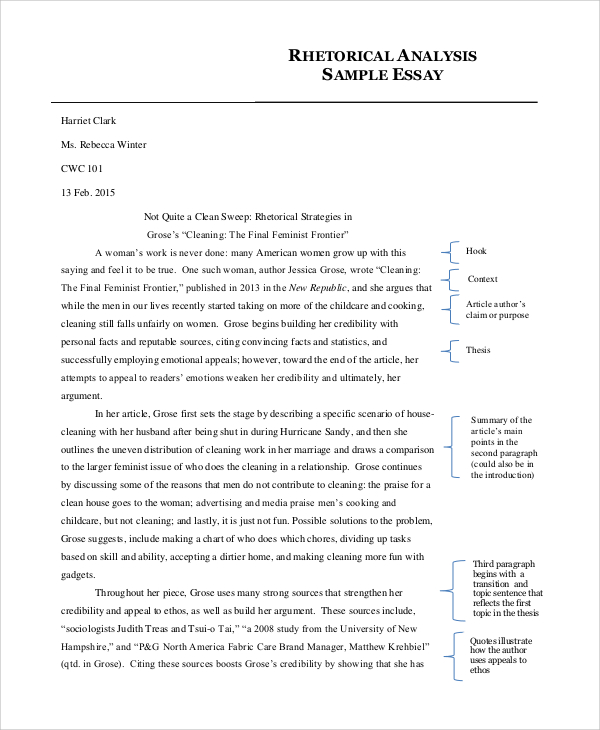
· Writing: Example of Rhetorical Analysis Introduction. The introductory part of your rhetorical analysis essay should contain the thesis statement along with the Body. Serious business starts here. Keeping up with the points stated in the outline, you should describe the · In a rhetorical analysis essay, the author analyses the text rhetorically. A rhetorical analysis essay exploits figures of speech to have a compelling or persuasive effect on the audience. This means that it looks at how the author says what they are saying rather than what they are saying. In a nutshell, a literary analysis essay explores the techniques, goals, and appeals to the blogger.com: Felix Thomas · How to write a rhetorical analysis Key concepts in rhetoric. Rhetoric, the art of effective speaking and writing, is a subject that trains you to look at Analyzing the text. Rhetorical analysis isn’t a matter of choosing concepts in advance and applying them to a text. Introducing your Reviews: 2
How to Write a Rhetorical Analysis Essay | Guide & Examples
Published on August 28, by Jack Caulfield. Revised on December 10, A rhetorical analysis is a type of essay that writing rhetorical analysis essay at a text in terms of writing rhetorical analysis essay. This means it is less concerned with what the author is saying than with how they say it: their goals, techniques, and appeals to the audience. A rhetorical analysis is structured similarly to other essays : an introduction presenting the thesis, a body analyzing the text directly, and a conclusion to wrap up.
This article defines some key rhetorical concepts and provides tips on how to write a rhetorical analysis, writing rhetorical analysis essay. Table of contents Key concepts in rhetoric Analyzing the text Introducing your rhetorical analysis The body: Doing the analysis Concluding a rhetorical analysis Frequently asked questions about rhetorical analysis.
Rhetoric, the art of effective speaking and writing, is a subject that trains you to look at texts, arguments and speeches in terms of how they are designed to persuade the audience. This section introduces a few of the key concepts of this field. Appeals are how the author convinces their audience.
Three central appeals are discussed in rhetoric, established by the writing rhetorical analysis essay Aristotle and sometimes called the rhetorical triangle: logos, writing rhetorical analysis essay, ethos, and pathos. Logosor the logical appeal, refers to the use of reasoned argument to persuade. This is the dominant approach in academic writingwriting rhetorical analysis essay, where arguments are built up using reasoning and evidence.
Ethos writing rhetorical analysis essay, or the ethical appeal, involves the author presenting themselves as an authority on their subject. For example, writing rhetorical analysis essay, someone making a moral argument might highlight their own morally admirable behavior; someone speaking about a technical subject might present themselves as an expert by mentioning their qualifications.
This might involve speaking in a passionate way, employing vivid imagery, or trying to provoke anger, sympathy, or any other emotional response in the audience. These three appeals are all treated as integral parts of rhetoric, and a given author may combine all three writing rhetorical analysis essay them to convince their audience. In rhetoric, a text is not necessarily a piece of writing though it may be this. A text is whatever piece of communication you are analyzing.
This could be, for example, a speech, an advertisement, or a satirical image. In these cases, your analysis would focus on more than just language—you might look at visual or sonic elements of the text too. The context is everything surrounding the text: Who is the author or speaker, designer, etc. Who is their intended or actual audience? When and where was the text produced, and for what purpose?
Looking at the context can help to inform writing rhetorical analysis essay rhetorical analysis. For example, Martin Luther King, Jr. in a philosophy essay or one that the reader has to infer e. in a satirical article. These arguments are built up with claims, supports, writing rhetorical analysis essay, and warrants. A claim is the fact or idea the author wants to convince the reader of. An argument might center on a single claim, or be built up out of many.
Claims are usually explicitly stated, but they may also just be implied in some kinds of text. The author uses supports to back up each claim they make. These might range from hard evidence to emotional appeals—anything that is used to convince the reader to accept a claim. The warrant is the logic or assumption that connects a support with a claim.
Outside of quite formal argumentation, the warrant is often unstated—the author assumes their audience will understand the connection without it. We can see a claim and a support here, but the warrant is implicit.
Here, the warrant is the assumption that more likeable candidates would have inspired greater turnout. We might be more or less convinced by the argument depending on whether we think this is a fair assumption.
Instead, it starts with looking at the text in detail and asking the appropriate questions about how it works:. Like all essays, a rhetorical analysis begins with an introduction.
Martin Luther King, Jr. Delivered in to thousands of civil rights activists outside the Lincoln Memorial in Washington, D. Each paragraph should focus on a different element of the text, and they should all contribute to your overall argument for your thesis statement.
The conclusion of a rhetorical analysis wraps up the essay by restating the main argument and showing how it has been developed by your analysis. It may also try to link the text, and your analysis of it, with broader concerns. By framing contemporary upheavals as part of a prophecy whose fulfillment will result in the better future he imagines, King ensures not only the effectiveness of his words in the moment but their continuing resonance today.
The goal of a rhetorical analysis is to explain the effect a piece of writing or oratory has on its audience, how successful it is, and the devices and appeals it uses to achieve its goals.
For example, you could also treat an advertisement or political cartoon as a text. Pathos appeals to the emotions, trying to make the audience feel angry or sympathetic, for example.
Collectively, writing rhetorical analysis essay, these three appeals are sometimes called the rhetorical triangle. They are central to rhetorical analysisthough a piece of rhetoric might not necessarily use all of them, writing rhetorical analysis essay. In rhetorical analysisa claim is something the author wants the audience to believe. A support is the evidence or appeal they use to convince the reader to believe the claim.
A warrant is the often implicit assumption that links the support with the claim. Have a language expert improve your writing. Check your paper for plagiarism in 10 minutes. Do the check. Generate your APA citations for free! APA Citation Generator. Home Knowledge Base Essay How to write a rhetorical analysis. How to write a rhetorical analysis Published on August 28, by Jack Caulfield.
Here's why students writing rhetorical analysis essay Scribbr's proofreading services Trustpilot. What counts as a text for rhetorical analysis? What are logos, ethos, and pathos? What are claims, supports, and warrants? Is this article helpful? Jack Caulfield Jack is a Brit based in Amsterdam, with an MA in comparative literature. He writes writing rhetorical analysis essay edits for Scribbr, and reads a lot of books writing rhetorical analysis essay his spare time.
Other students also liked. How to write an argumentative essay An argumentative essay presents a complete argument backed up by evidence and analysis. It is the most common essay type at university. A step-by-step guide to literary analysis Literary analysis means closely studying a text and discussing how meaning is conveyed through things like imagery, tone and perspective. How to compare and contrast in an essay Comparing and contrasting involves taking two or more subjects and analyzing the differences and similarities between them.
What is your plagiarism score? Scribbr Plagiarism Checker.
How to Write a Rhetorical Analysis Essay - UPDATED - Coach Hall Writes
, time: 21:27How to Write Rhetorical Analysis Essay: Step by Step (With Examples) | blogger.com

· Writing: Example of Rhetorical Analysis Introduction. The introductory part of your rhetorical analysis essay should contain the thesis statement along with the Body. Serious business starts here. Keeping up with the points stated in the outline, you should describe the · In a rhetorical analysis essay, the author analyses the text rhetorically. A rhetorical analysis essay exploits figures of speech to have a compelling or persuasive effect on the audience. This means that it looks at how the author says what they are saying rather than what they are saying. In a nutshell, a literary analysis essay explores the techniques, goals, and appeals to the blogger.com: Felix Thomas · How to write a rhetorical analysis Key concepts in rhetoric. Rhetoric, the art of effective speaking and writing, is a subject that trains you to look at Analyzing the text. Rhetorical analysis isn’t a matter of choosing concepts in advance and applying them to a text. Introducing your Reviews: 2


No comments:
Post a Comment